what is Social Engineering Attacks
Introduction to Social Engineering
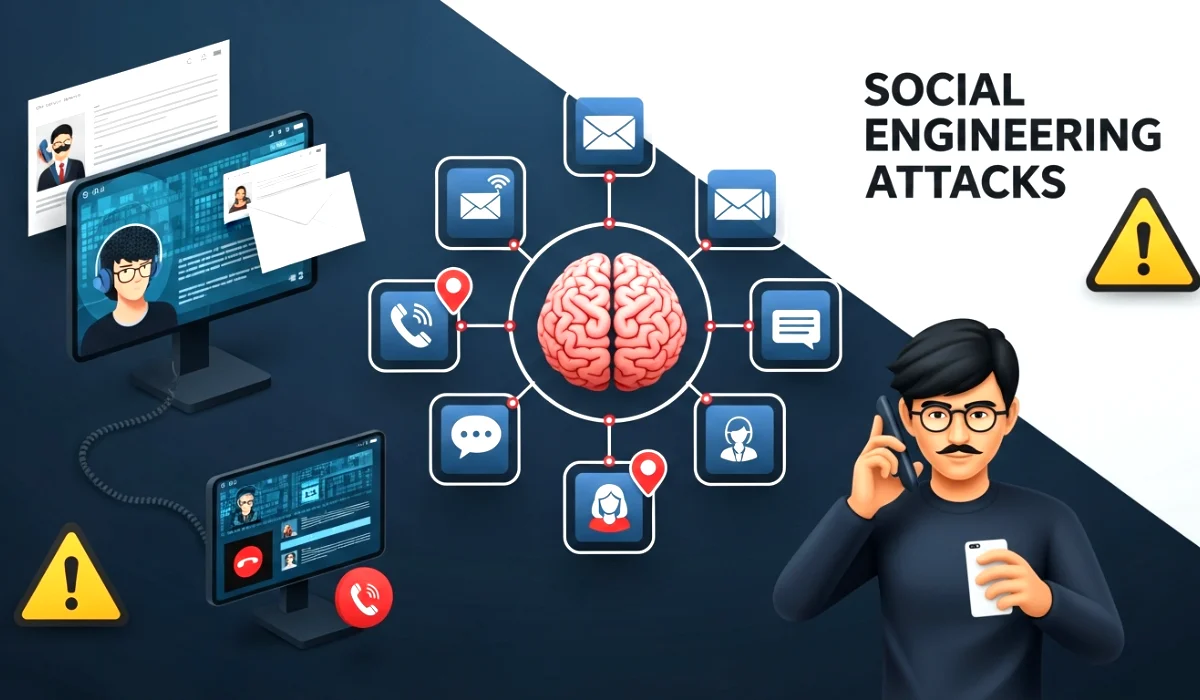
Social Engineering is a cyber attack technique that focuses on manipulating people instead of hacking systems. In these attacks, criminals use psychological tricks to convince victims to reveal confidential information such as passwords, OTPs, banking details, login credentials, or company data.
In simple terms:
Social Engineering means hacking the human mind, not the computer.
Even if an organization has strong firewalls and advanced security systems, attackers often find it easier to exploit human trust, fear, and emotions. That is why social engineering remains one of the most successful and dangerous attack methods in cybersecurity today.
Why Social Engineering Attacks Are So Effective
Social engineering works because it targets natural human behavior. Attackers commonly take advantage of:
- Trust in authority (IT staff, bank, police, HR, etc.)
- Fear (account blocked, legal action, security breach)
- Urgency (act now, limited time, immediate verification)
- Curiosity (free gift, unknown attachment, surprising message)
- Greed (prizes, cashback, job offers)
- Helpfulness (people wanting to assist others)
Example:
An employee receives a call:
“This is from the IT department. Your system has been infected. Share your login details immediately to fix it.”
Due to fear and urgency, the employee may unknowingly share credentials.
you can also read : Cyber Threat Landscape: A Deep and Practical Overview
Common Types of Social Engineering Attacks
1. Phishing
Phishing is the most common type of social engineering attack. Attackers send fake emails or messages that appear to come from trusted organizations like banks, PayPal, Amazon, or government agencies.
Example:
You receive an email saying:
“Your bank account will be suspended. Click here to verify your account.”
The link leads to a fake website that looks real. When you enter your username and password, the attacker steals your information.
2. Spear Phishing
Spear phishing is a targeted form of phishing. Instead of sending mass emails, attackers target a specific person, company, or department using personal details.
Example:
An attacker sends an email pretending to be your HR manager:
“Hi Rahul, please review the attached salary document urgently.”
The attachment contains malware that infects your system.
3. Vishing (Voice Phishing)
Vishing uses phone calls to trick victims into sharing sensitive data.
Example:
A fake bank representative calls and says:
“Your debit card is about to be blocked. Please share the OTP for verification.”
Once the OTP is shared, money is withdrawn from the account.
4. Smishing (SMS Phishing)
Smishing is phishing through SMS or text messages.
Example:
You receive a message:
“You have won ₹10,000 cashback. Click the link to claim now.”
The link may install malware or lead to a fake page that steals your personal data.
5. Pretexting
In pretexting, the attacker creates a fake story or identity to gain the victim’s trust.
Example:
An attacker pretends to be an external auditor and asks an employee for confidential financial records, claiming it is an “urgent management request.”
6. Baiting
Baiting involves offering something attractive to trick victims.
Example:
A USB drive labeled “Salary Data” or “Free Movies” is left in an office or public place.
When someone plugs it into their computer, malware is automatically installed.
7. Tailgating / Piggybacking
This is a physical social engineering attack where an attacker gains unauthorized access to a restricted area.
Example:
An attacker follows an employee into a secure office area and says:
“I forgot my access card, can you hold the door?”
Out of politeness, the employee allows entry.
Real-World Impact of Social Engineering
Social engineering attacks can cause serious damage, including:
- Financial fraud and monetary loss
- Identity theft
- Data breaches
- Loss of customer trust
- Legal and compliance issues
- Damage to company reputation
In countries like India, many UPI scams, fake KYC calls, courier scams, and fake customer care numbers are classic examples of social engineering.
How to Prevent Social Engineering Attacks
For Individuals:
- Never share OTPs, passwords, CVV, or PINs
- Do not click on unknown or suspicious links
- Verify sender email addresses carefully
- Be cautious of urgent or threatening messages
- Use Two-Factor Authentication (2FA)
- Install apps only from official app stores
For Organizations:
- Conduct regular employee security awareness training
- Run phishing simulation campaigns
- Enforce strict verification procedures
- Use least-privilege access policies
- Encourage employees to report suspicious activity
- Follow a Zero Trust security model
Conclusion
Social engineering attacks prove that humans are often the weakest link in cybersecurity. No matter how strong your technical defenses are, a single mistake by a user can compromise an entire system. The best protection is a combination of strong security controls and continuous user awareness and education.
By staying alert, questioning unusual requests, and following security best practices, individuals and organizations can significantly reduce the risk of becoming victims of social engineering attacks.
Frequently Asked Questions (FAQ)
1. What is a social engineering attack in cybersecurity?
A social engineering attack is a method where attackers manipulate people into giving away sensitive information such as passwords, OTPs, banking details, or company data. Instead of breaking technical security, attackers exploit human psychology like trust, fear, and urgency.
2. Why are social engineering attacks more successful than technical hacking?
Because humans are easier to trick than computer systems. Even with strong firewalls and antivirus software, a single careless click or shared OTP can give attackers full access. Social engineering targets human emotions, not software vulnerabilities.
3. What is the difference between phishing and spear phishing?
Phishing is a mass attack where the same fake message is sent to many people. Spear phishing is a targeted attack focused on a specific person, company, or department using personalized information to appear more trustworthy.
4. How can individuals protect themselves from social engineering scams?
Individuals should never share OTPs or passwords, avoid clicking unknown links, verify suspicious calls or emails, enable two-factor authentication, and be careful with urgent or threatening messages that pressure them to act quickly.
5. Are social engineering attacks only online?
No. Social engineering can also happen offline, such as tailgating into secure buildings, fake identity verification, or tricking employees in person to gain physical access to restricted areas or confidential documents.